

A double-density PU sole, weighed layer by layer
A worked example in grams shows how mould volume, foam density and tread shape influence the weight of a polyurethane sole.
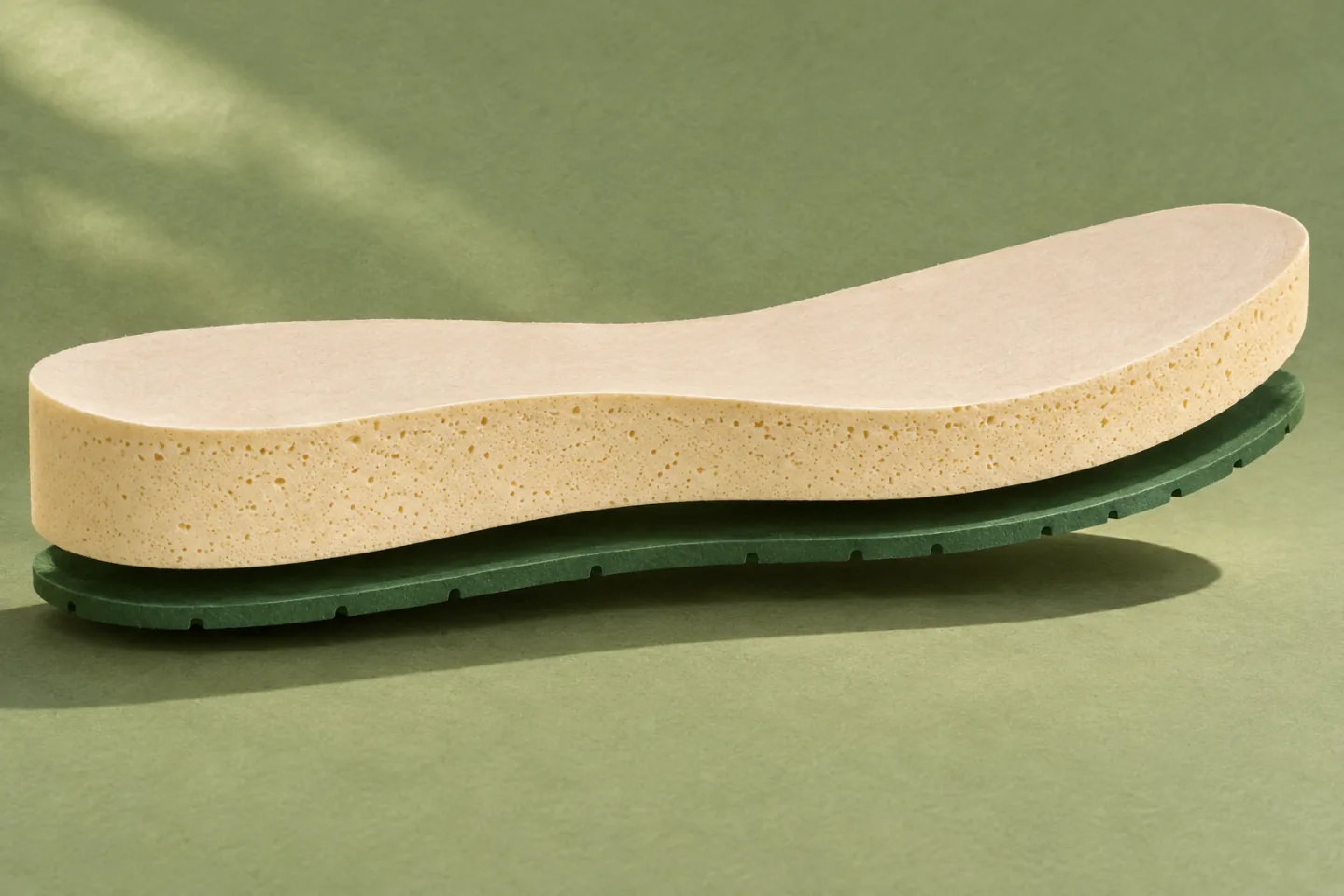
Why put two densities in one sole?
A double-density polyurethane sole pairs a lower-density midsole beneath the foot with a denser outsole against the ground. The midsole gives the designer room to build in cushioning. The outsole carries the tread and takes the rubbing that comes with walking. At a footwear counter in Bengal, a customer can lift a Thesis sandal by one strap and feel its weight before trying it on. That first impression of weight begins with choices made inside the sole mould.
Polyurethane, shortened to PU, starts as liquid components that react in a mould. In a cellular formulation, gas pockets occupy part of the finished volume. A cubic centimetre containing more gas generally weighs less than the same volume of otherwise comparable material. A mould also gives the sidewall its outline, including the small rise at the toe that can make a sole look thinner in profile.
In one direct moulding method the outsole goes into the bottom of the tool first. A second shot fills the cavity between outsole and upper and forms the midsole. Where the two meet is a design decision too. A section cut through the heel lets a technician see whether the boundary lies where the drawing put it. Comparing sections of the same size also reveals how much of a tall heel consists of the lighter material and where the tread begins underfoot.
How does density translate into grams?
Start with one imaginary sole in one size. Give its midsole a moulded volume of 180 cubic centimetres and an apparent density of 0.35 grams per cubic centimetre. Multiply the two and the midsole weighs 63 grams. Give the outsole 60 cubic centimetres at 0.80 grams per cubic centimetre. That contributes another 48 grams, bringing the sole to 111 grams before adding an upper, lining or fastening.
Now keep the external silhouette and move ten cubic centimetres from the lighter region into the denser tread region. The midsole loses 3.5 grams. The outsole gains eight. The revised sole weighs 115.5 grams. Those figures belong to the example. To quote a weight for a catalogue article, we would need the finished sample, its size and a scale. At a dealer’s counter, check whether a quoted weight covers one shoe, the pair or both shoes in their box.
| Layer | Volume (cm³) | Density (g/cm³) | Mass (g) |
|---|---|---|---|
| Midsole | 180 | 0.35 | 63 |
| Outsole | 60 | 0.80 | 48 |
| Complete sole | 240 | 0.4625 | 111 |
What can a side view tell you?
Look along the ground edge of a sandal. The gaps between tread blocks take material out of the moulded part. A broad heel or a deeper sidewall puts volume back in. Two soles can share a compound and finish at different weights simply because the designer distributed it differently. That is why our catalogue photographs are worth looking at from toe to heel.
Density describes mass per volume. Hardness describes resistance to indentation. A supplier can report both on the same sheet alongside abrasion loss and flex results. The units beside each number matter. At the counter, start with the article and size, ask which layers it uses, then lift the actual pair. Your hand can compare its weight. The specification supplies the detail your hand cannot measure.