

What earns a material its place in a pair?
How Thesis thinks about buying footwear materials, from the thickness of an EVA sheet and the finish on a strap to the next delivery of the same colour.
What is the material being asked to do?
For Thesis, the finest raw material is one we can specify for its place in a finished pair. Our founder, Kishore Singhal, brought experience in EVA sheets and in import and export to footwear manufacturing in Bengal. A buyer may order whole rolls of upper material to make a strap barely two fingers wide. How neatly its edge turns in that narrow space makes a difference you can feel under your thumb at the counter.
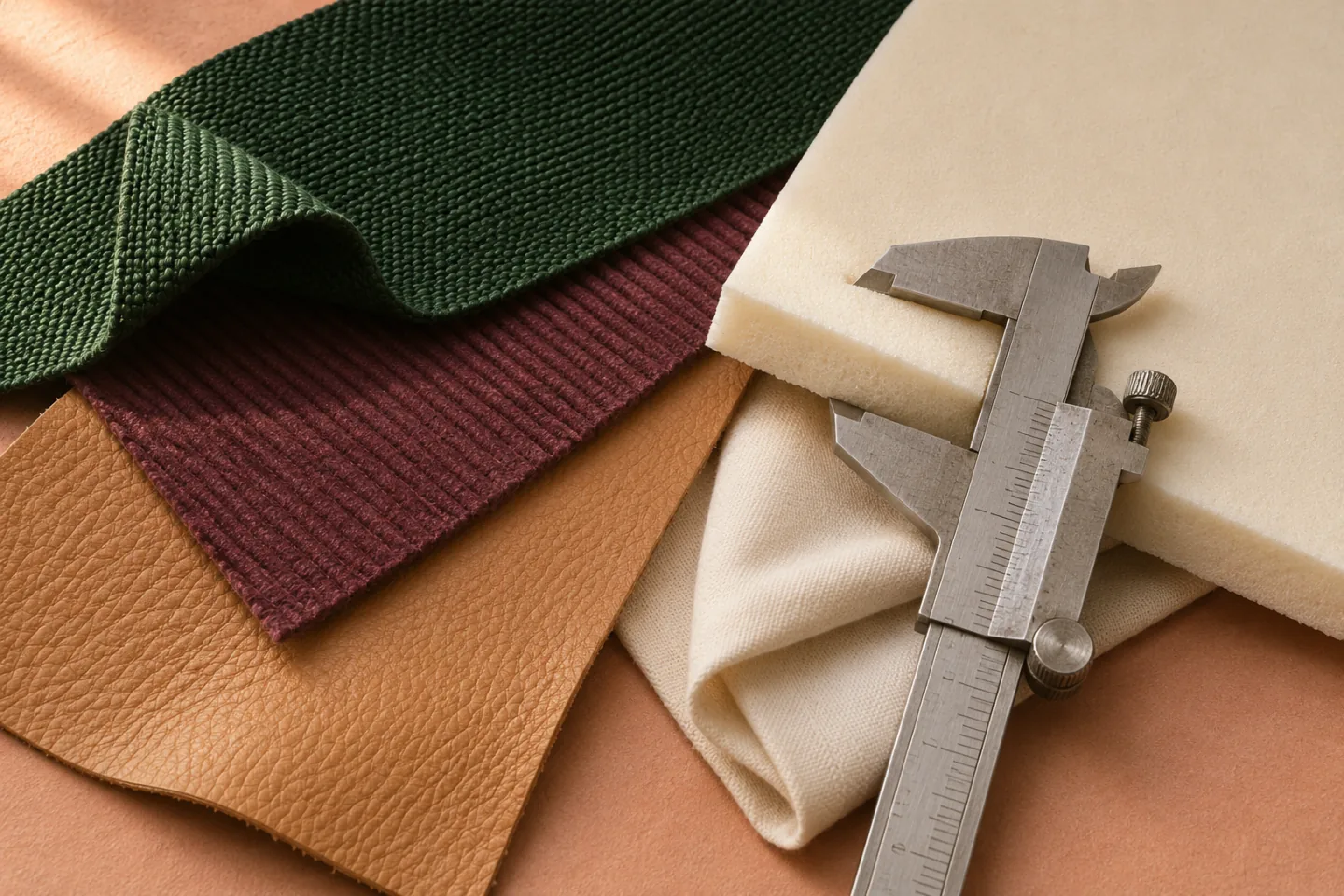
Take a sheet of ethylene vinyl acetate, commonly called EVA. Two offcuts on a table can look identical from above. Turn them on edge and a difference in thickness becomes visible. For a buyer comparing samples, thickness in millimetres, density and the intended position in the shoe all belong on the enquiry. A larger piece allows measurements at several points. One tidy corner tells you little about the rest of a sheet.
What does a swatch leave out?
A strap sample needs a different conversation. Fold it into the curve it would take over the foot. The turned edge exposes the backing, the surface finish and the space available for stitching. Put the swatch beside the footbed colour. A warm brown can look quite different against cream and against black. This is the scale at which we want to make a colour decision, with its neighbour in sight.
There is a practical cost hidden in a sample’s dimensions. A narrow usable width can leave a cutting layout a whole strap short across a sheet. Ask for the usable area and for the direction of any grain or surface pattern. A tiny patch on a sample card may fit a child’s strap beautifully. Laying out a full size run shows where the same pattern lands on a much broader one.
Colour also has a life beyond the sample card. In footwear testing, rubbing a coloured material against a reference fabric can reveal transfer. Dry and damp conditions answer different questions about the same surface. Abrasion testing follows another kind of damage, the gradual wearing away of material. A buyer asking for results needs the material identity, the method and the conditions so that two results can be compared fairly.
Can the next order match?
For a moulded PU sole, a useful supplier discussion starts with the intended component and the properties of the finished material. A liquid system in a drum and the cellular solid it becomes occupy different volumes. Ask which density the sheet reports and how the specimen was prepared. Keep the supplier’s material reference attached to the answer. A familiar colour name is a poor way to identify a formulation months later.
Repeatability matters to the dealer who opens a second carton. Imagine setting a new delivery beside the last pair on display. The eye goes straight to a change in the strap shade or the height of an edge. An agreed sample, a batch reference and a recorded difference give the buyer something definite to discuss with the supplier. That continuity is the quality we want a dealer to recognise on the shelf.